

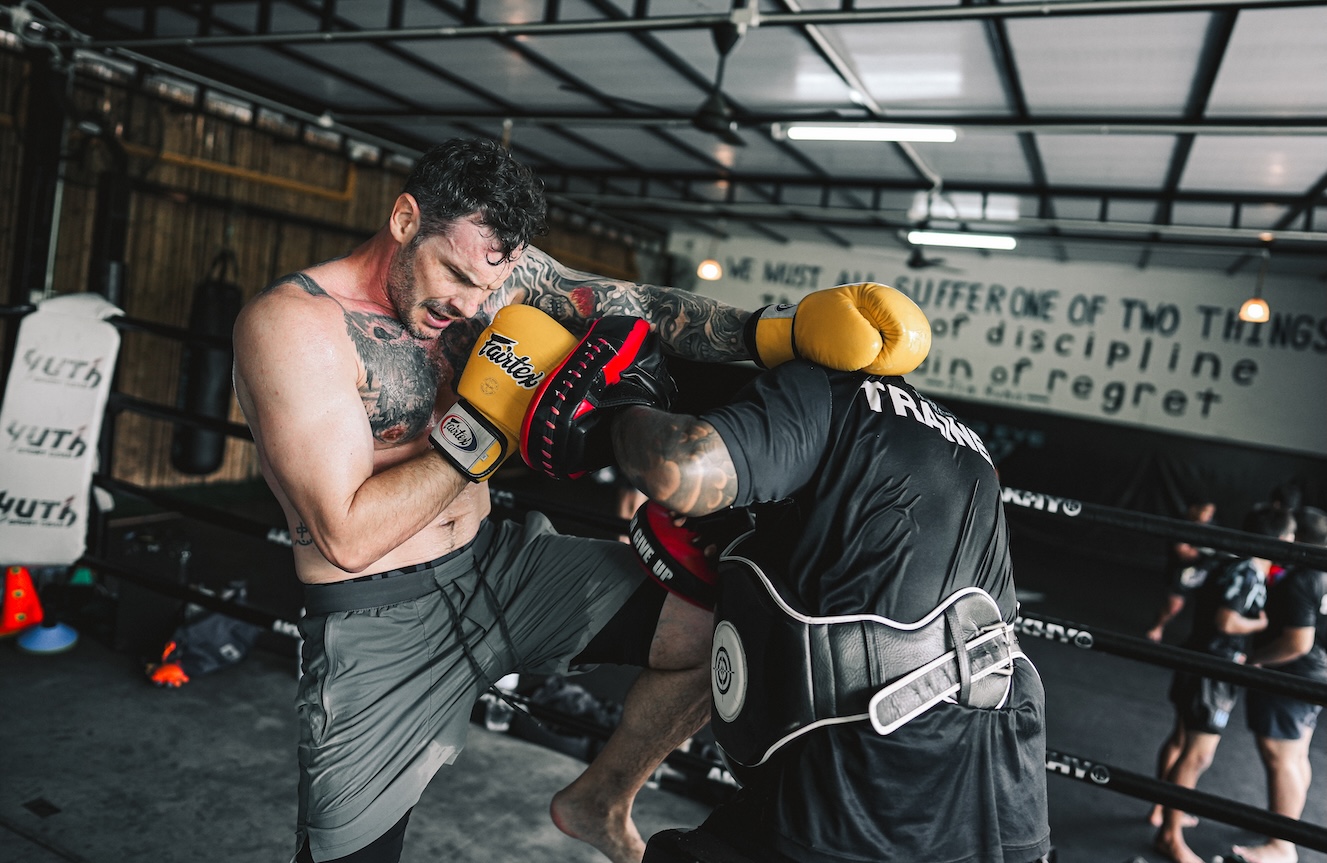
“Am I ready to fight?”
It’s one of those questions that sounds like it should have a simple answer.
How long have you been training?
How good is your technique?
How fit are you?
How do you do in sparring?
Those things matter. But there is no black-and-white answer, and there certainly isn’t a magic number of months you need to train before you are “ready.”
For me, readiness to fight comes down to two broad things: where you are mentally and emotionally, and where you are technically.
And of those two, the mental side is usually more important.
The Two Extremes

Imagine two people at opposite ends of the spectrum.
The first person has almost no formal martial arts training. But maybe they spent years working as a bouncer. They’ve been involved in physical altercations. They know what it feels like when another person is genuinely trying to hurt them. They don’t freeze when someone gets aggressive. They can remain functional while adrenaline is pumping.
Let’s say that person comes into my gym, trains for a week, and says, “I want to fight.”
Could they fight?
Yes.
That might sound crazy, but depending on the circumstances, I might say that person is ready to fight.
Would I necessarily want them representing my team after one week of training? Probably not.
That is a different question.
As a coach, I don’t particularly want someone going out there wearing our gym’s name while throwing wild punches and flailing around because they haven’t developed their technique yet. But that doesn’t mean they are incapable of fighting.
In fact, aggression, composure, toughness and confidence can compensate for a surprising amount of technical deficiency, particularly at lower levels.
You don’t have to look pretty to win a fight.
Thailand is a particularly good example because fights are plentiful and the cultural attitude toward competing can sometimes be less monumental than it is in the West. Fighting doesn’t necessarily have to be treated as this enormous event that requires a year of preparation and a dramatic transformation into a “fighter.”
Sometimes you just fight.
Now consider the opposite person.
They’ve trained for two years.
Technically, they’re excellent. Their punches are sharp. Their kicks are clean. They understand defense. They move well. They know combinations. Maybe they look fantastic hitting pads.
But perhaps they weren’t naturally aggressive growing up. Maybe they were bullied. Maybe confrontation makes them uncomfortable. They’ve never actually been in a fight.
Through sparring, they’ve gradually become more confident. They’re learning not to panic when someone hits them.
Technically, this person might be vastly superior to our hypothetical bouncer.
But put both of them into an actual fight and something interesting can happen.
The technically inferior person might function perfectly well.
The technically superior person might completely fall apart.
That doesn’t mean the second person shouldn’t fight. After enough training and enough progressive exposure to pressure, they may absolutely be ready.
They simply arrived at readiness from the opposite direction.
One person already had the mentality and needed the technique.
The other had to develop the technique while slowly developing the mentality.
Most people, of course, aren’t either extreme. They’re somewhere in between.
So What Do We Mean by a “Fight”?
Before asking whether you’re ready to fight, we should define what fighting actually means.
There is a spectrum.
At one end is normal technical sparring.
You can flow. You can play. You can touch each other. You can work combinations and experiment. Nobody is trying to hurt anybody.
You can look fantastic doing this.
Then the power increases.
Suddenly, things change.
The beautiful combinations disappear. Your breathing changes. You start blinking. Maybe you’re flinching. Maybe you’re turning away. Maybe everything you know technically starts disappearing.
That’s important information.
So before talking about amateur fights, professional fights or even smokers, I think there is a useful Level Zero.
Level Zero: Fighting Someone You Trust

Level Zero happens inside the gym.
You are still sparring someone you know and trust. There is still a coach there. There are still rules and precautions.
But you and your partner have agreed that you’re going hard enough that getting hurt is a genuine possibility.
That doesn’t mean you’re trying to knock each other out. In fact, you should still be looking after your training partner.
But you’ve crossed an important line.
If someone were accidentally dropped or knocked out, nobody would say, “What the hell were you doing?”
Everyone understood beforehand that this was a possibility.
That’s very different from regular Tuesday-night sparring with recreational students. If somebody gets knocked unconscious there because you decided to unload on them, you’ve massively overstepped your bounds.
Level Zero is different because both people have knowingly agreed to raise the stakes.
And I think this is where you can start learning something very important about yourself.
What happens to you when the consequences become real?
Do you flinch?
Do you turn away?
Do you panic?
Do you stop thinking?
Do you become emotional every time you get hit?
Do you feel the need to acknowledge every good shot your partner lands—“Nice one!”—because psychologically you’re still treating the exchange as cooperative sparring?
Or can you remain calm?
Can you get hit, register what happened, make an adjustment and continue?
Can you stay cold and calculated without becoming reckless or angry?
And just as importantly, can you recognize when your partner is hurt and maintain control?
Because being comfortable with violence isn’t the same thing as losing control.
This kind of hard sparring shouldn’t be something you’re constantly doing. There are obvious costs to repeatedly taking hard shots in training. But as a test, it can answer questions that hitting pads and light technical sparring cannot.
This is the first threshold.
Level One: Fighting Someone Who Isn’t Your Teammate

Once you’ve crossed Level Zero, another door opens.
Now you’re dealing with someone you don’t train with.
They’re from another gym.
They don’t know you.
And most importantly, they aren’t responsible for taking care of you in the same way your teammate is.
That changes things psychologically.
This is where smokers, interclubs and amateur competition start entering the picture.
The exact format isn’t particularly important. What matters is that you’re crossing another threshold.
At Level Zero, you’re experiencing real pressure with someone you trust.
At Level One, you’re experiencing real pressure against an opponent.
There’s an uncertainty there that doesn’t exist with your regular training partners.
You don’t know exactly how hard they’re going to come out.
You don’t know their rhythms.
You don’t know how they’re going to react when you hit them.
And when you get tired or hurt, you can’t assume they’re going to recognize it and back off.
Now you’re competing.
The Escalation Ladder
This is why I don’t particularly like answering “Am I ready to fight?” by looking at someone’s training history and saying:
“You’ve trained six months. You’re ready.”
Or:
“You’ve only trained three months. You’re not ready.”
Those statements don’t tell me enough.
I would rather progressively increase the stakes and watch what happens.
Technical sparring tells me something.
Hard sparring tells me something else.
Facing someone outside your own team tells me considerably more.
Competition tells me even more.
Each step exposes you to a little more uncertainty, a little more danger and a little more psychological pressure.
And at every stage, you learn something about yourself.
Mental Readiness Can Shorten the Technical Road
This brings us back to the two people we started with.
Someone who already has experience functioning under genuine physical confrontation may be able to fight surprisingly early in their martial arts training.
They still need technique. They still need coaching. They still need conditioning. And there’s a difference between being capable of fighting and being ready to represent a serious team competitively.
But psychologically, they may already possess something that takes another student years to develop.
Meanwhile, someone else might need those years.
Neither path is necessarily better.
They simply started in different places.
This is also why comparing yourself to somebody else based purely on how long they’ve trained doesn’t make much sense.
Six months for one person isn’t the same as six months for another.
The Real Question
So when someone asks me:
“Am I ready to fight?”
I’m not primarily interested in how many months they’ve trained.
I’m looking at what happens when the pressure rises.
Can you continue thinking when somebody is trying to hit you hard?
Can you execute technique when you’re scared?
Can you get hit without emotionally unraveling?
Can you remain aggressive when aggression is required without becoming reckless?
Can you control yourself when you’re winning?
Can you keep functioning when you’re losing?
And when the comfortable environment of cooperative training disappears, how much of your actual martial arts ability remains?
That’s where I start looking for the answer.
Because ultimately, you don’t really find out whether somebody is ready to fight by watching what they can do when everything is comfortable.
You find out by progressively making things uncomfortable and seeing what remains.