

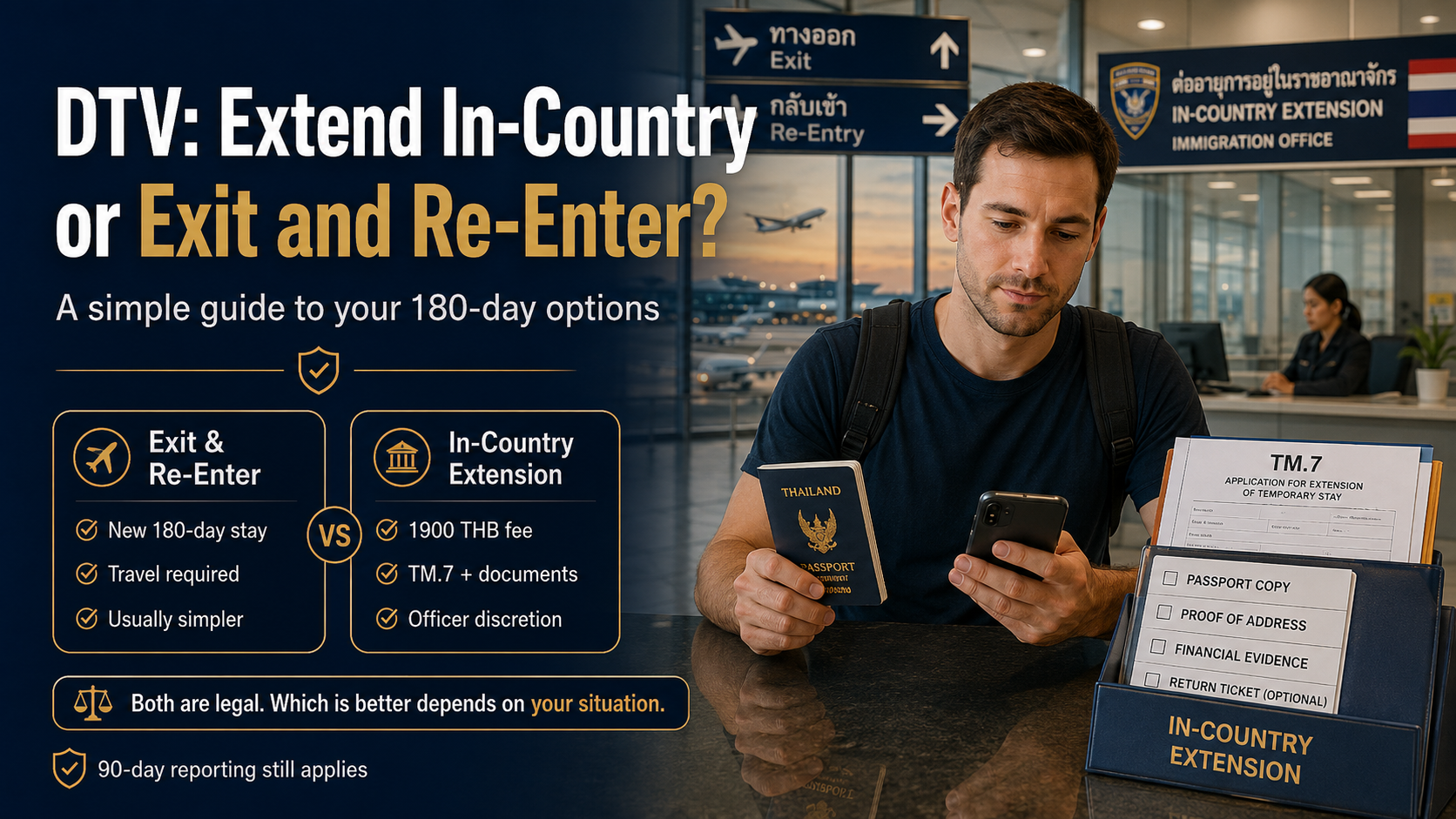
Once you are settled in Thailand on your Destination Thailand Visa, one question eventually comes up for every long-term resident: when your 180-day entry stamp is approaching its end, should you extend your stay at a Thai immigration office, or should you simply leave Thailand and come back?
Both options are legitimate. Which one is right for you depends on your circumstances, your travel preferences, and your tolerance for paperwork.
Here is a clear breakdown of both options.
Option 1: Exit and Re-Enter
You can exit Thailand and come back to receive a new 180-day stay. This is essentially a legal visa run, and many digital nomads prefer this option because it is usually simpler and quicker.
The mechanics are straightforward. If you leave Thailand and return before your DTV expires, you simply present your passport and enter normally. Your new entry grants another 180 days. You can re-enter unlimited times across the five-year visa validity.
No documents are required beyond your passport and your DTV. No forms to complete at an immigration office. No queuing, no officer discretion, no fees beyond your travel costs.
The most common destinations for a quick border run are Malaysia, Cambodia, Laos, and Vietnam, which are all easily reachable from Bangkok by flight. Many DTV holders combine this with a short trip they would have taken anyway, making the re-entry a natural part of their lifestyle rather than an administrative chore.
Option 2: In-Country Extension
DTV holders may extend their stay for an additional 180 days at the Thai Immigration Office. This allows for a total stay of up to approximately one year, 180 days plus a 180-day extension before an exit and re-entry is required.
The extension fee is 1,900 THB. You will need to visit your local immigration office, complete a TM.7 form, and provide supporting documentation including your passport, proof of address, and financial evidence. Bangkok residents typically use the Chaeng Wattana immigration office. Those in Chiang Mai, Phuket, and Pattaya can use their respective local offices.
Extension is granted at the discretion of the immigration officer. You may be asked additional questions or for photos verifying your activity in Thailand, particularly for training, digital nomad work, or wellness programmes.
It is worth noting that you can only extend once inside Thailand per entry. After that, you must exit and re-enter to reset the 180-day allowance.
Which Option Is Better?
For most DTV holders, exiting and re-entering is the simpler and lower-risk option. It requires no documentation, no officer discretion, no queuing at an immigration office, and no fees beyond travel costs. It also resets your 180-day clock cleanly and immediately upon re-entry.
The in-country extension makes more sense if you genuinely do not want to leave Thailand at all, for work, personal, or medical reasons, and you are prepared to visit the immigration office with your documents in order.
One practical note: if you choose to extend in-country, make sure your financial documentation is current. Bank statements showing your 500,000 THB balance and any supporting evidence related to your qualifying activity should be prepared in advance.
90-Day Reporting
Regardless of which option you choose, remember that DTV holders who remain in Thailand for more than 90 consecutive days are required to submit a 90-day address report confirming their current place of residence. This can usually be done online through the Thai immigration portal. Tiger Eye’s packages include assistance with this process.
The Bottom Line
If you value simplicity, exit and re-enter. If you want to stay in Thailand continuously for close to a full year without leaving, apply for the in-country extension. Both are valid, legal options and entirely compatible with holding a DTV under the Soft Power route.
Note: This article is intended for informational purposes only. Immigration rules and embassy requirements can change. Always verify current requirements with an official source or qualified immigration adviser before making decisions.