

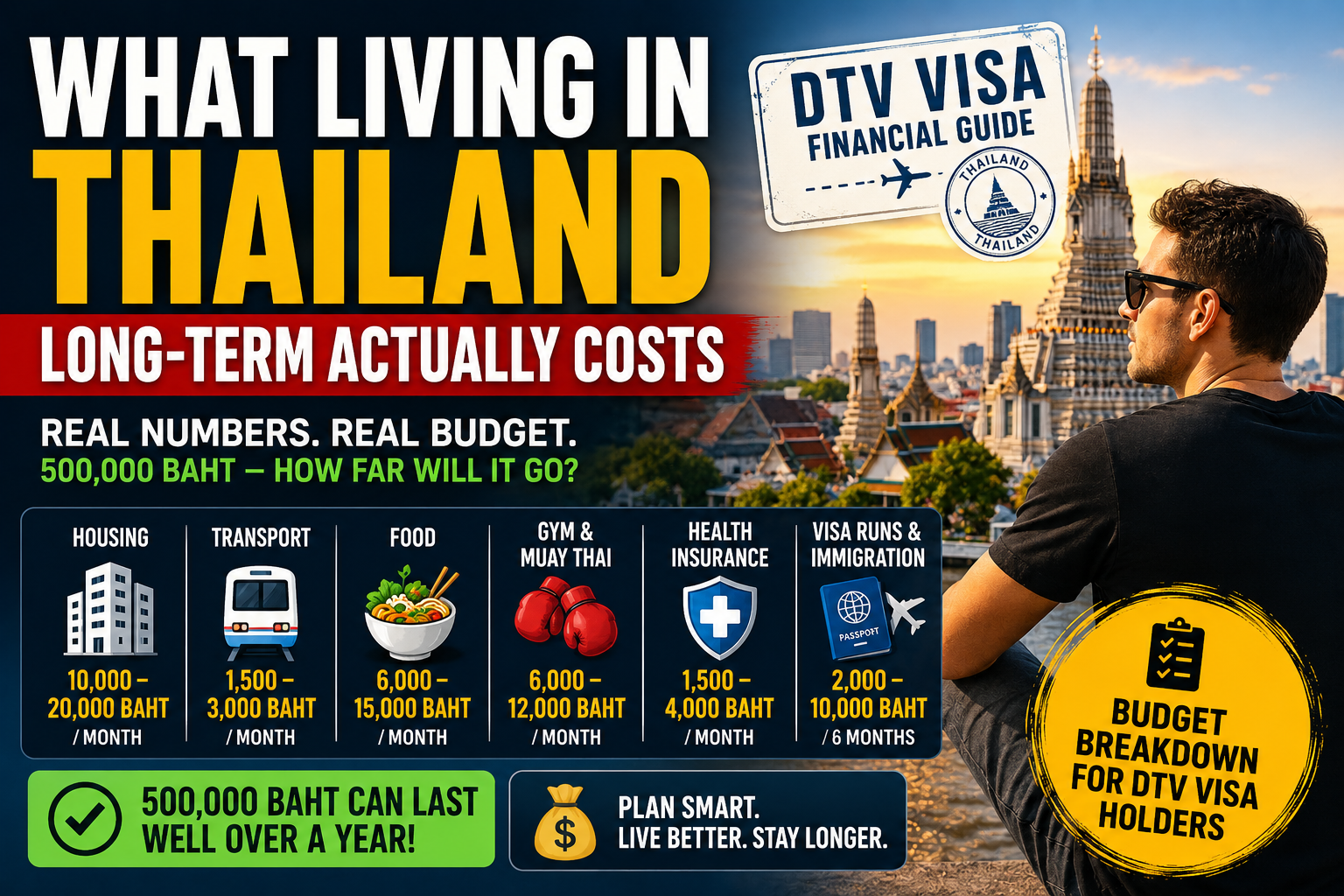
What Living in Thailand Long-Term Actually Costs
So you’re thinking about making the move to Thailand. You’ve already looked into the Destination Thailand Visa (DTV) and seen that the minimum financial requirement is 500,000 Thai baht in your bank account.
But here’s a question worth asking before you apply: how long will that money actually last?
This matters more than most people realise. Embassy officials reviewing your DTV application are not just checking whether you hit the minimum threshold. They want to understand whether your finances make sense for a long-term stay. If your savings run out in six months, that would describe someone who qualifies for a tourist visa, not a 5-year DTV.
The good news is that Thailand, particularly Bangkok, is affordable. With a realistic budget, 500,000 baht can last well over a year. Here is what that actually looks like on the ground.
Housing
Bangkok offers a wide range of accommodation depending on your expectations.
A basic but clean studio apartment in a decent area of Bangkok will typically cost between 8,000 and 15,000 baht per month. For that, you can expect air conditioning, a private bathroom, and, in newer buildings, access to a communal pool or gym.
If you want something more comfortable, such as a larger studio or one-bedroom in a well-located building near a BTS station, expect to pay between 15,000 and 25,000 baht per month.
Luxury condos and serviced apartments with hotel-style amenities can push well past 30,000 baht, but most long-term residents find the mid-range more than sufficient.
Realistic monthly budget: 10,000 – 20,000 baht
Transportation
Bangkok’s public transport is efficient and cheap. The BTS Skytrain and MRT cover most of the city, and a single journey rarely costs more than 60 baht. A monthly commuter pass runs around 1,300 to 1,500 baht, depending on your route.
Grab (the regional equivalent of Uber) is widely used for shorter trips or areas not covered by rail, and fares are reasonable. Motorbike taxis are the fastest and cheapest option for short distances, typically 20 to 50 baht per ride.
If you are not commuting daily and rely on a mix of BTS and Grab, your transport costs will likely stay well under 3,000 baht a month.
Realistic monthly budget: 1,500 – 3,000 baht
Food
This is where Bangkok surprises people.
Street food and local restaurants remain some of the best values in the world. A full meal from a street stall or local shophouse costs between 50 and 100 baht. Eat three meals a day this way, and you are spending around 4,500 to 9,000 baht a month on food alone, with the additional benefit of eating very well!
Western restaurants, malls, and delivery apps will push costs higher. A meal at a mid-range Western restaurant can run 300 to 600 baht, and regular delivery adds up quickly.
Most long-term residents mix local eating with occasional Western meals and keep food costs manageable.
Realistic monthly budget: 6,000 – 15,000 baht
Gym and Muay Thai Training
If you are in Thailand on a DTV soft power visa, training costs are part of your life here, and they are worth budgeting for properly.
A quality Muay Thai gym in Bangkok typically charges between 6,000 and 12,000 baht per month for unlimited training. Some gyms offer shorter packages or drop-in rates, but for a long-term stay, a monthly membership makes the most financial sense.
At Tiger Eye MMA, we offer training packages designed specifically for long-term residents and DTV holders. Whether you are a complete beginner or have years of experience, our programs cover Muay Thai, BJJ, and MMA, and our team can also handle the certified enrollment documentation you need for your DTV application. It is one of the few places in Bangkok where your training and your visa support are handled under the same roof.
If you are training at a gym that also issued your DTV enrollment documents, you are already committed to a program. Factor this into your monthly budget from day one; it is not an optional expense, it is part of what makes your application legitimate.
Realistic monthly budget: 6,000 – 12,000 baht
Health Insurance
This is one area where cutting corners can be costly.
Thailand has excellent private hospitals, but they are not cheap without coverage. A single emergency room visit at a private hospital can easily run 10,000 to 50,000 baht or more, depending on the situation.
For long-term residents, international health insurance is strongly recommended. A basic plan for a healthy adult in their 20s or 30s can start around 1,500 to 3,000 baht per month, with more comprehensive coverage running higher.
Some people rely on Thailand’s government hospitals for minor issues, which are far cheaper, but for anything serious, you will want private hospital access and insurance to cover it.
Realistic monthly budget: 1,500 – 4,000 baht
Visa Runs and Immigration Costs
The DTV allows a 180-day stay per entry. When that window closes, you either exit and re-enter Thailand or extend at a local immigration office.
A border run to a neighbouring country, such as Malaysia, Cambodia, or Laos, can be done for as little as 2,000 to 5,000 baht, including transport, depending on how you do it. Some people fly to a nearby city for a long weekend, which costs more but is a more enjoyable experience.
Extending your visa at an immigration office in Thailand costs around 1,900 baht and saves you the trip entirely.
Plan for this cost roughly twice a year if you intend to stay continuously.
Realistic biannual budget: 2,000 – 10,000 baht per exit or extension
Emergencies
No budget is complete without a buffer for the unexpected, a medical issue, a broken phone, a last-minute flight, or a month where costs run higher than planned.
A sensible emergency reserve for long-term living in Thailand is 20,000 to 50,000 baht set aside and not counted as part of your monthly spending.
What Does This All Add Up To?
Here is what a realistic monthly budget looks like in Bangkok across three spending levels:
Budget lifestyle — Local food, basic accommodation, public transport, training included: Around 25,000 – 35,000 baht per month
Comfortable lifestyle — Mid-range apartment, mix of local and Western food, Grab regularly, training included: Around 40,000 – 55,000 baht per month
Comfortable with extras — Better apartment, eating out freely, travel within Thailand, all costs covered: Around 60,000 – 80,000 baht per month
So What Does This Mean for Your DTV Application?
The minimum financial requirement for the DTV is 500,000 baht. At a budget lifestyle, that covers roughly 14 to 20 months of living expenses. At a comfortable level, it covers 9 to 12 months.
Either way, 500,000 baht demonstrates that you can sustain yourself in Thailand well beyond the six-month mark, which is exactly what separates a DTV applicant from someone who simply needs a tourist visa.
If your savings would realistically run out at or before six months, an embassy may question whether the DTV is the right visa for your situation. This is why having supplemental income, remote work, freelancing, or passive income, strengthens your application significantly, even if it is modest.
The DTV is designed for people who are genuinely building a life in Thailand, even temporarily. Your finances should reflect that.
FAQ: Cost of Living in Thailand
Is 500,000 baht enough to live in Thailand long-term? Yes, for most people living modestly to comfortably. At a budget level, it can last well over a year. Having an income source alongside your savings makes your situation significantly stronger.
Do I need to show the full 500,000 baht throughout my stay? The 500,000 baht requirement applies at the time of application. However, demonstrating that your finances will sustain you long-term strengthens your case for the DTV over a tourist visa.
Is Bangkok more expensive than other parts of Thailand? Yes, but not dramatically so for most categories. Accommodation tends to be the biggest variable. Chiang Mai and other cities can be somewhat cheaper for housing.
Can I work remotely while on the DTV soft power visa? The soft power DTV is specifically for cultural activities. If you intend to work remotely, the remote work category of the DTV may be more appropriate for your situation.
For more information and to speak to someone from the team Click Here