

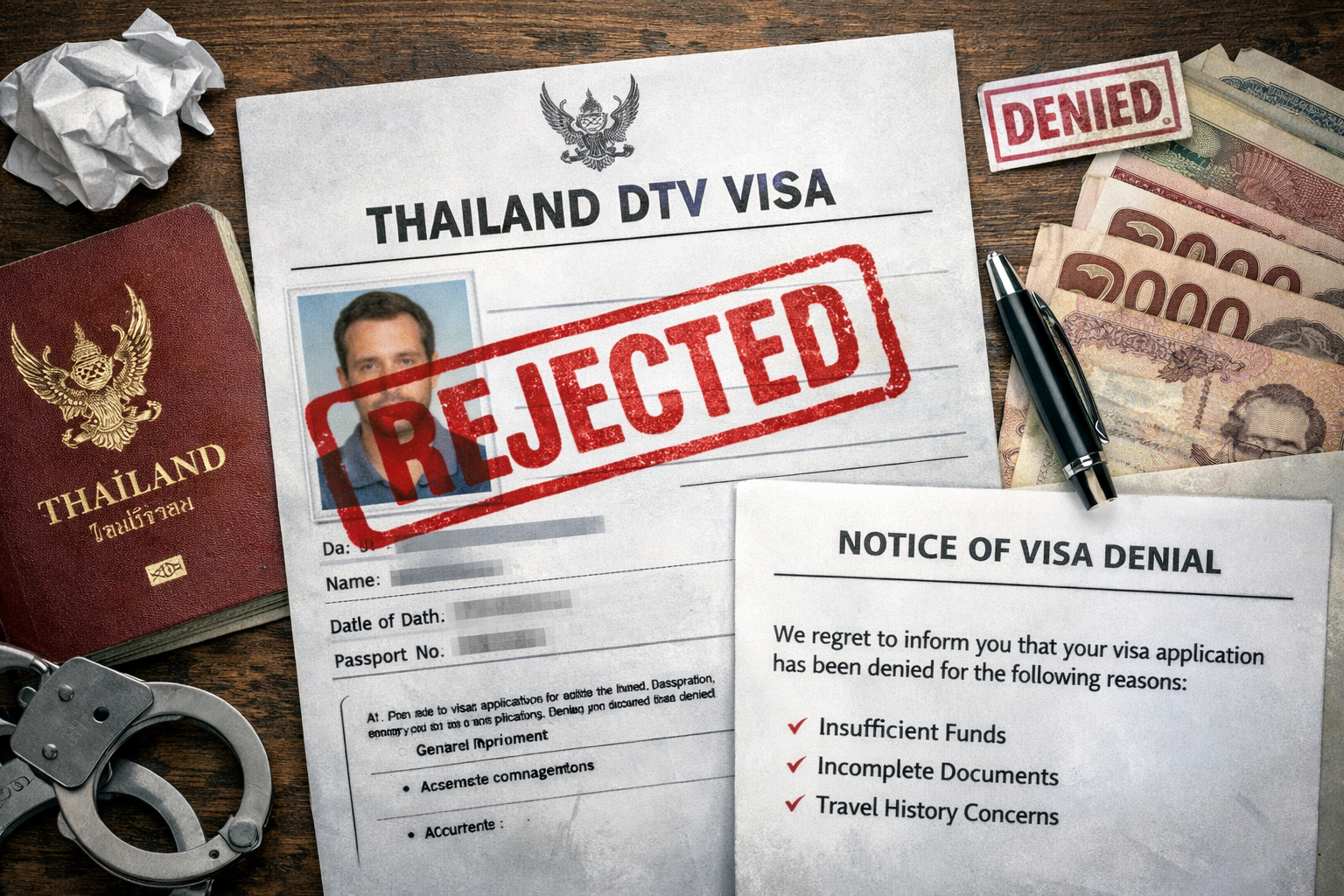
One of the biggest misconceptions I see around the DTV visa is that rejections are random.
They’re not.
In fact, after working with hundreds of applications across dozens of embassies, the pattern is very clear:
Most rejections come down to one thing — weak financial proof.
But here’s where people get it wrong.
They think “financial proof” just means having 500,000 THB in their account.
It doesn’t.
The 500,000 THB Requirement — And Why It’s Not Enough
Yes, the baseline requirement is straightforward:
- You need at least 500,000 THB in your account
- Typically shown over 3–6 months of bank statements
But if you think that simply hitting that number guarantees approval, you’re missing how embassies actually evaluate applications.
Because what they’re really asking is:
“Does this person make sense financially over the next 5 years?”
And that’s a completely different question.
What Embassies Are Actually Looking For
When an embassy reviews your application, they’re not just checking a box.
They’re looking at the big picture.
This includes:
- Your savings (yes, the 500,000 THB)
- Your income
- Your financial consistency
- Your age and life situation
- And whether your story makes sense
I’ve seen this firsthand, especially in places like Ho Chi Minh City, where follow-up requests often include questions like:
- “How do you intend to support yourself over 5 years?”
- “Do you have proof of income?”
And honestly — it’s a fair question.
Because no one is realistically living off 500,000 baht for five years.
The “Big Picture” Problem Most Applicants Miss
Let’s take a real-world scenario.
Say you’re 21 years old.
You have 500,000 THB in your account.
You apply for a DTV visa.
On paper, you meet the requirement.
But from the embassy’s perspective, they’re thinking:
- Where did this money come from?
- How will you sustain yourself long-term?
- Are you actually planning to stay, or just cycle in and out?
Now — and this is important — it doesn’t mean you’ll be rejected.
There are completely reasonable explanations.
For example:
- You live at home
- You’ve been saving aggressively
- You plan to train, leave, work, and return
That’s all valid.
But if that story isn’t clear in your application, then you’re leaving room for doubt.
And doubt is what leads to rejections.
Weak Financial Proof Isn’t Just About Amount
When I say “weak financial proof,” I don’t mean:
“You didn’t have enough money.”
What I mean is:
- Your statements don’t show consistency
- Your deposits look sudden or unexplained
- There’s no supporting income documentation
- The numbers don’t match your story
For example:
- A large lump sum appearing right before applying
- No visible income source
- Irregular account activity
- Missing explanation of where funds came from
These are all red flags.
Even if the balance says 500,000 THB.
The Second Major Issue: No Proof of Income
This is something I strongly recommend to every applicant:
Don’t just show savings — show income.
Even though the official requirement focuses on funds, embassies increasingly want to see:
- Salary
- Freelance income
- Business revenue
- Rental income
- Any consistent source of funds
Because again — they’re thinking long-term.
If you can clearly show:
- “Here’s my savings”
- “Here’s how I earn”
Then your application becomes significantly stronger.
What a Strong Financial Profile Looks Like
A strong application typically includes:
- Clean bank statements over 3–6 months
- No sudden unexplained deposits
- A stable balance above the minimum
- Clear income documentation
- Supporting explanation (if needed)
And most importantly:
Everything tells the same story.
Other Common Reasons for Rejection
While financial proof is the biggest factor, it’s not the only one.
Other issues I’ve seen include:
1. Poor Document Presentation
Messy, incomplete, or unclear documents create friction and doubt.
2. Wrong Embassy Choice
Some embassies are simply stricter than others.
3. Weak Narrative
If your application doesn’t clearly explain why you’re applying, it can raise questions.
4. Inconsistencies
Anything that doesn’t line up — even small details — can trigger deeper scrutiny.
How to Avoid Rejection (Simple Framework)
If you want to maximize your chances of approval, focus on this:
1. Build Financial Clarity
Don’t just meet the requirement — make it make sense.
2. Show Income
Even if it’s not required, it strengthens your case significantly.
3. Keep Everything Consistent
Your documents, your story, your numbers — all aligned.
4. Choose the Right Embassy
This matters more than most people think.
5. Don’t Rush It
A rushed application is almost always a weaker one.
Final Thoughts
Most DTV visa rejections are not bad luck.
They’re predictable.
And in most cases, they could have been avoided with better preparation.
If you understand how embassies actually think — and present your application accordingly — your chances of approval go up dramatically.
If You Want to Get It Right the First Time
Every applicant’s situation is different.
Your age, your finances, your background, your embassy — all of it plays a role.
If you’re unsure whether your application is strong enough, it’s always better to fix things before you apply rather than after a rejection.
For more information on how to apply for a DTV with Tiger Eye click here